Cost estimation for construction projects forms the financial backbone of every successful development. Whether constructing a residential house in Lahore, a commercial plaza in Islamabad, or an industrial facility in Punjab, accurate cost estimation ensures that the project remains financially viable from planning to completion. Without a structured estimate, even technically sound projects may suffer from delays, disputes, and budget overruns.
At CiviTeach, we provide professional construction cost estimation services across Lahore and Pakistan. Our approach combines engineering expertise, quantity surveying standards, real-time supplier rates, and escalation modeling to deliver dependable and transparent cost forecasts.
Also read: Complete building cost estimation solutions at CiviTech.
Table of Contents
What Is a Cost Estimate, and Why Is It Important?
A cost estimate is a structured calculation of the total expected expenses required to complete a construction project. It includes direct costs such as materials and labor, as well as indirect costs like supervision, overhead, and contingency.
Why Cost Estimation Is Important
- Supports informed investment decisions
- Prevents budget overruns
- Improves resource allocation
- Strengthens contractor-client trust
- Enables accurate bidding and tendering
At CiviTeach, we often see projects fail due to underestimation of structural steel quantities or fluctuating cement prices in Pakistan’s volatile market. A well-prepared cost estimate reduces these risks and enhances financial predictability.
What Are the Types of Construction Cost Estimation?
Different project stages require different levels of estimation accuracy.
Preliminary (Conceptual) Estimate
This estimate is prepared during the early planning stage. It is usually based on cost per square foot or historical data from similar projects. It helps determine whether a project is financially viable before detailed drawings are ready.
Detailed Estimate
A detailed estimate is prepared after architectural, structural, and MEP drawings are finalized. It includes item-by-item quantity takeoff and rate analysis. This type provides the highest level of accuracy.
Quantity Estimate
This estimate focuses on measuring quantities of materials such as concrete, steel, bricks, plaster, and finishes from drawings.
Bid Estimate
Contractors prepare bid estimates for tender submission. These estimates include profit margins and competitive pricing strategies.
Control Estimate
A control estimate is used during construction to track actual expenses against the approved budget.
At CiviTeach, we often begin residential projects in Lahore with a conceptual estimate and later refine it into a detailed BOQ-based estimate.
What Are the Key Components of a Construction Estimate?

A reliable construction estimate contains multiple structured components. These ensure that no cost category is overlooked.
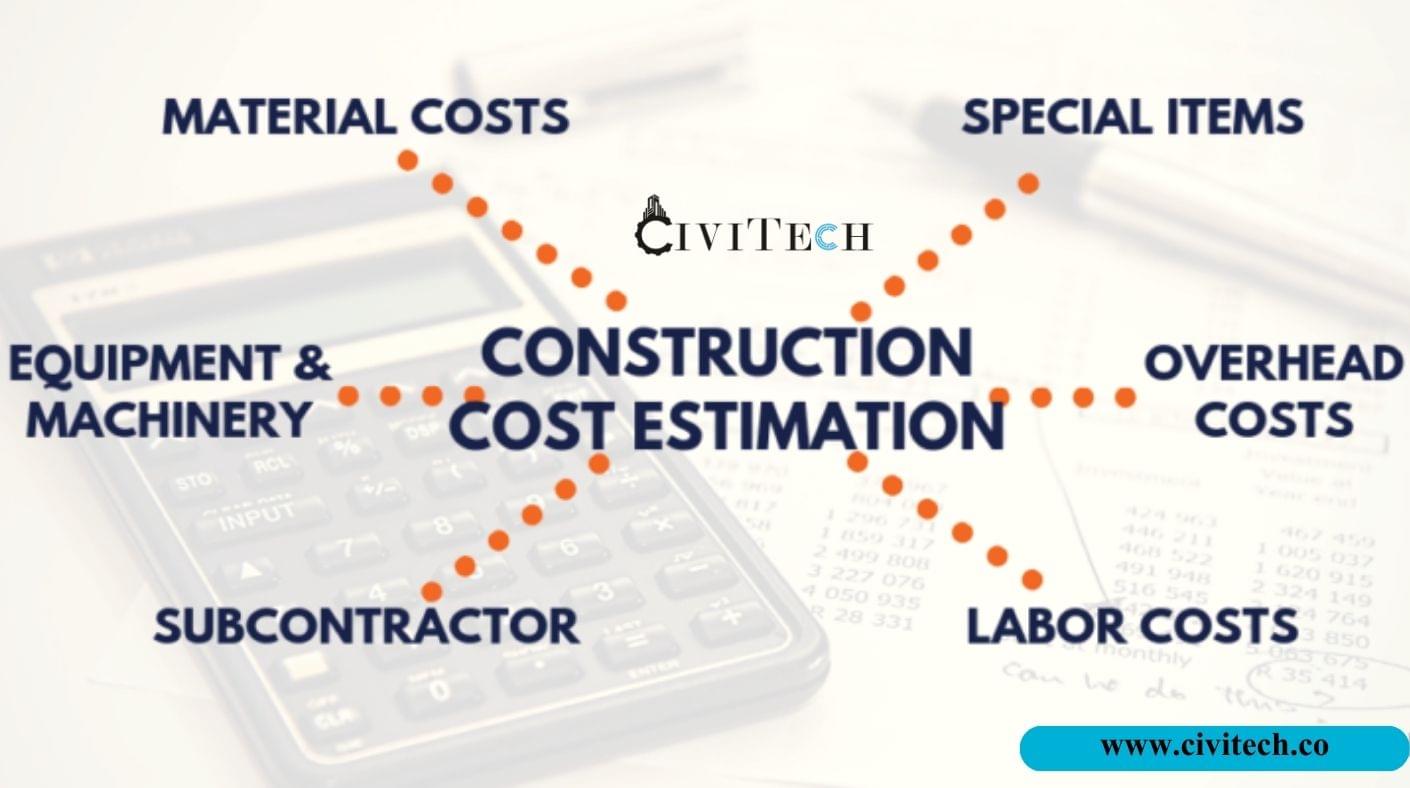
Direct Costs
Direct costs are expenses directly related to physical construction work. These typically include:
- Construction materials such as cement, steel, bricks
- Skilled and unskilled labor wages
- Equipment and machinery rental
- Subcontractor services
Indirect Costs
Indirect costs support site operations but are not tied to specific building elements. These include supervision, site utilities, insurance, and safety arrangements.
Overheads and Profit
Contractors include administrative overhead and reasonable profit margins depending on project complexity.
Contingency Allowance
A contingency of 5% to 15% is commonly added to manage unforeseen circumstances such as minor design changes or rate fluctuations.
At CiviTeach, our engineering team double-checks RCC quantities before pricing because minor steel miscalculations can significantly affect total budgets.
What Is the Difference Between Accuracy and Precision?
Accuracy refers to how close an estimate is to the actual final project cost. Precision refers to the level of detail and consistency in the calculations.
For example, a highly detailed steel calculation using outdated rates may be precise but inaccurate. Professional estimation requires both updated market validation and careful quantity measurement.
How to Perform a Construction Cost Estimate?
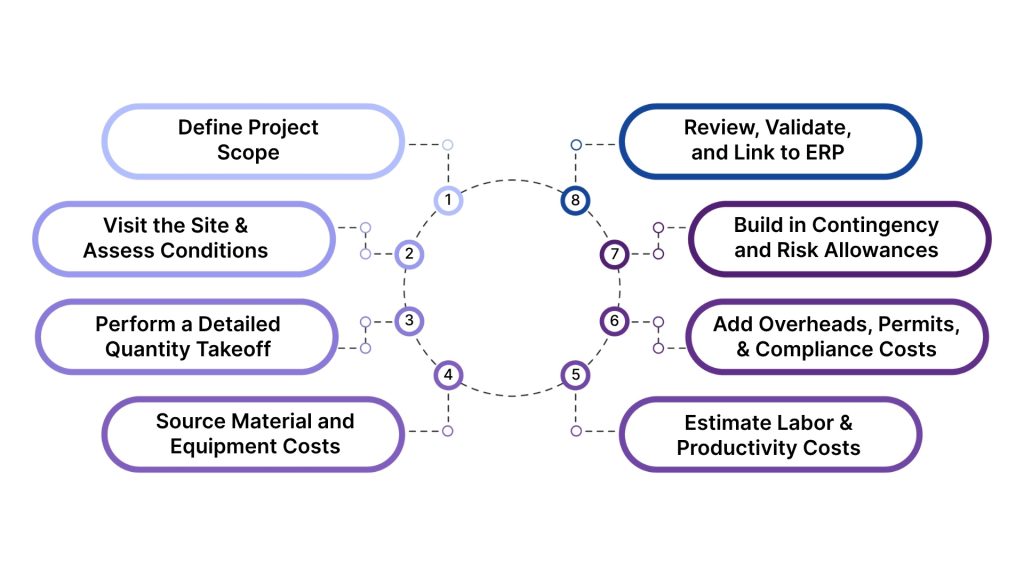
Performing a construction cost estimate requires a structured workflow.
The process generally includes:
- Reviewing architectural, structural, and MEP drawings
- Performing detailed quantity takeoff
- Applying updated material unit rates
- Calculating labor productivity and wages
- Adding indirect costs, overhead, and contingency
- Conducting final verification and review
Each step must be carefully validated to prevent financial errors. At CiviTeach, we often conduct site inspections in Lahore to verify project assumptions before finalizing estimates.
How to Estimate Costs for Modular and Prefabricated Construction Projects
Modular and prefabricated construction differs from traditional RCC systems in cost structure. Major cost factors include factory fabrication, transportation logistics, and crane installation. However, modular systems often reduce construction time and minimize on-site labor costs.
When estimating prefabricated steel buildings in Pakistan, consider:
- Transportation distance from factory to site
- Crane capacity requirements
- Assembly time and labor productivity
Although initial material costs may appear higher, reduced project duration can significantly lower indirect expenses. CiviTeach evaluates both initial investment and lifecycle savings before recommending modular solutions.
How to Model Escalation in a Cost Estimate
Escalation modeling is essential for long-term projects. In Pakistan, steel and fuel price volatility directly affects project budgets.
Common escalation methods include:
- Applying projected annual inflation rates
- Using historical price trend analysis
- Including contractual price adjustment clauses
Ignoring escalation can lead to severe financial gaps. For projects exceeding twelve months, escalation allowances are strongly recommended.
How to Review Cost Estimates
| Item description | Checklist | Potential red flags |
| Total cost estimate | • Is the total project cost comparable to similar projects? • What is included and excluded in the total cost? | Have a sense-check about the usual cost of that project to avoid an excessively expensive price. Find other projects’ prices for comparison. |
| Project scope | • Has the overall scope been covered? | Ensure no missing scope to avoid cost escalation later. |
| Key assumptions | • What assumptions are made in the estimate? • Do the assumptions make sense? | Assumptions are accepted in the cost estimate, but have some sense-check around those assumptions and data |
| Key components | • Are the key components (PMT, engineering, procurement, and construction) already covered? • What is the percentage cost of each component? | There is a rule of thumb for the percentage cost for each component as described in the previous section. Pay attention to the component with an unusually high percentage. |
| PMT | • Are key personnel for the project already included? • Has it considered both direct & indirect personnel? | Beware if PMT takes a large proportion of the project cost. |
| Engineering | • Are key engineering documents already included? • Does it include as-built documents? | Have your lead engineer check the engineering documents list. Also, ensure that as-built documents are included in the project close-out later. |
| Procurement | • Are all key materials and equipment already included? • Does it include packing, delivery, and preservation on-site? • Any warranty for the materials? | Check the delivery terms of the materials. Also, material preservation is important in a multi-year project. |
| Construction | • Does it have a detailed construction schedule? • What is the manpower rate and quantity? • What is the assumed productivity rate? | Construction is typically the largest cost component. Check the detailed schedule. Also, check the productivity assumptions (e.g., how many steel structures in kilograms can be built per day) |
| Cost risk | • Does it have a cost risk management plan? • What is included in the risks? • What is the total risked value? | Keep an eye on project risk, as it can significantly impact costs. Ensure that the major risks have been identified. |
Cost estimate review ensures reliability and transparency. A proper review typically involves checking quantities, validating rates, and confirming productivity assumptions.
Key review points include:
- Cross-checking quantities against drawings
- Verifying supplier quotations
- Confirming labor productivity benchmarks
- Ensuring appropriate contingency inclusion
Independent peer review increases confidence, especially for commercial or institutional projects.
What Are Common Mistakes in Cost Estimation?
Several recurring mistakes reduce estimate reliability. These include incomplete drawing analysis, ignoring indirect costs, underestimating labor productivity, and excluding contingency allowances. Another major issue in Pakistan is relying on outdated supplier rates. Even small steel price changes can significantly affect high-rise building budgets. Professional discipline and continuous market monitoring reduce these risks.
| Challenge | Impact | How to Avoid It |
|---|---|---|
| Market Volatility and Material Price Fluctuations | Steel, cement, and asphalt prices can shift quickly due to global supply and oil price changes. | Use updated supplier quotes, and include escalation clauses and periodic rate reviews. |
| Labor Costs and Availability Issues | Labor shortages or wage hikes can push project costs beyond plan. | Maintain a database of current labor rates and secure multiple manpower suppliers early. |
| Poor Scope Definition | Vague or incomplete scopes lead to overruns and disputes. | Clearly define the project scope and document all inclusions, exclusions, and assumptions. |
| Outdated Unit Rates | Using old data results in inaccurate projections. | Update cost databases quarterly and benchmark against recent Saudi projects. |
| No or Low Contingency | Leaves no room for unexpected costs or changes. | Always include a 5–15% contingency depending on project risk and complexity. |
| Ignoring Financial Charges and Taxes | Overlooking VAT, duties, or financing costs skews totals. | Add all statutory charges and financing costs, and stay compliant with Saudi VAT rules. |
| Weak Change Control | Untracked variations quietly drain budgets. | Implement strict change-approval workflows and update cost reports after every variation. |
How Do We Manage Uncertainties in Labor Costs?
Labor cost uncertainty is common due to seasonal demand, skilled labor shortages, and productivity variations.
Effective labor cost management involves:
- Monitoring regional wage trends
- Using historical productivity benchmarks
- Including buffer allowances for overtime
- Adjusting rates for inflation impact
At CiviTeach, we maintain updated labor rate data across Lahore and Punjab to ensure realistic projections.
What Are Some Best Practices and Common Challenges in Cost Estimation?
Best practices in cost estimation include maintaining historical project databases, updating supplier rates regularly, integrating engineering review, and applying structured contingency planning. Common challenges include unstable material markets, incomplete documentation, design revisions, and unrealistic client expectations. Balancing engineering accuracy with financial forecasting ensures sustainable project budgeting.
What Tools Can You Use for Construction Cost Estimation?
Modern technology enhances estimation accuracy and efficiency.
Commonly used tools include:
- Microsoft Excel for customized BOQs
- Primavera P6 for cost-loaded scheduling
- PlanSwift for digital quantity takeoffs
- CostX for advanced measurement
- BIM platforms for integrated 3D cost modeling
At CiviTeach, BIM-based workflows improve coordination between design and budgeting teams for commercial projects.
Conclusion
Cost estimation for construction projects requires engineering precision, market awareness, and structured financial planning. From quantity takeoff to escalation modeling, every stage influences project stability and profitability.
At CiviTeach, we combine technical expertise with real-time market intelligence across Pakistan to deliver reliable, transparent, and data-driven cost estimates. Accurate cost estimation builds financial confidence before construction begins and ensures long-term project success.
Frequently Asked Questions (FAQ)
-
What is the purpose of cost estimation in construction projects?
The purpose is to predict project expenses accurately, helping clients and contractors plan, budget, and avoid unexpected financial risks.
-
How accurate is cost estimation in construction projects?
Accuracy depends on the project stage and method used. Preliminary estimates give a broad figure, while detailed estimates provide much higher accuracy.
-
What is the average construction cost per square foot in Pakistan?
Construction costs vary depending on location, material quality, and design complexity. In Lahore, grey structure costs depend heavily on current steel and cement market rates.
-
Who is responsible for cost estimation in construction projects?
Quantity surveyors, project managers, and contractors are often responsible, although input from engineers and designers is also important.
-
Can BIM improve cost estimation accuracy?
Yes. BIM reduces measurement errors and enhances coordination between design and financial planning teams.
-
What are the main types of construction cost estimates?
There are five key types: Order of Magnitude, Feasibility, Preliminary, Substantive, and Detailed estimates, each suited for different project stages.
-
What is the formula for cost estimation?
A common formula is:
Total Project Cost = Direct Costs (Materials + Labor + Equipment) + Indirect Costs + Contingency + Profit Margin.